
Real Presence: Luther vs Calvin

Is Christ’s body objectively present in the sacrament, according to John Calvin? Unfortunately, that depends on what you mean by “objective,” which is a slippery and ambiguous word with no exact equivalent in the 16th-century discussion. (The word did not begin to acquire its current range of meanings until the writings of Immanuel Kant in the late 18th century.) Still, we can always try defining our terms explicitly. And if we do that, we can identify one important sense of the phrase “objectively present,” in which Christ’s body is objectively present in the sacrament in the Lutheran and Roman Catholic views but not in Calvin’s.

For suppose we define “objectively present” as meaning “present independent of anyone’s state of mind,” where “state of mind” includes things like belief. Then Christ’s body is not objectively present in the sacrament in Calvin’s view but is objectively present in the Lutheran and Roman Catholic views. Let me illustrate. I may believe there is no bread present in the house, but be mistaken: my wife has bought bread and put it in the breadbox where it is objectively present despite my belief to the contrary. Likewise, I can even have bread objectively present in my mouth without believing it: suppose for instance I inattentively pop a piece of bread in my mouth thinking it’s a bit of rice cake. The bread is present in my mouth even though I don’t believe it. In precisely this sense, according to both Lutheran and Roman Catholic views, Christ’s body is objectively present in the mouth of all who partake in the sacrament, whether they believe it or not.

This is a form of Eucharistic presence that Calvin explicitly and repeatedly denies, and he quite astutely identifies it as the key point on which he differs from the Lutherans. The point even has a technical name: manducatio indignorum, or the eating of the unworthy. In the Lutheran view, even unbelievers and anyone else who unworthily partake of the supper have not only bread but Christ’s body in their mouths, whether they believe it or not. Calvin insists, on the contrary, that we do not partake of Christ’s body without faith.

In what sense, then, can a Calvinist say that Christ’s body is objectively present in the sacrament? I would suggest that according to Calvin’s view Christ’s body can rightly be said to be “objectively presented” to us. This seems to me a good description of the intention of Calvin’s characteristic language of Christ’s body being truly offered, exhibited, presented and even given to us.

Since that last verb can be misleading, let me clarify: when Calvin says the body of Christ is given to unbelievers in the supper, he means it is offered but not received, like a gift given but refused. People who partake of the sacrament without faith of course do not refuse the bread—they take it right into their mouths—but they do refuse Christ and his body. And their refusal is effective. Again, the Lutherans affirm the contrary: precisely in putting the bread in their mouths, all who partake of the sacrament put Christ’s body in their mouths, whether they believe it or not. Roman Catholics agree, except that they teach that the Eucharistic host is wholly Christ’s body under the appearance of bread. Those who partake of the sacrament, worthily or not, have no bread in their mouths at all, but only Christ’s body.

Calvin’s view that Christ’s body is objectively presented rather than objectively present–—as he would say, “truly presented to us” but not “enclosed in the bread” or “chewed with the teeth”—gives his teaching a distinctive place on the spectrum of Eucharistic doctrine. This is distinct not only from the Lutheran and Calvinist views but also from the low Protestant view usually attributed (I do not know how fairly) to Zwingli. In this low Protestant view the supper is merely a memorial, which means that the only link to Christ’s body is our state of mind, our faith. On the contrary, when Calvin insists that Christ’s body is truly presented, offered, and given to us, he is talking not about our state of mind but about the action of God, and perhaps the most important thing to pay attention to is the adverb truly, for what is at stake here is the truth of God’s word. Does God do as he says when he offers us Christ’s body? Calvin’s answer is an emphatic yes.

With this in view, we can see why Calvinist theologians insist on the objectivity of the sacrament. And we could explain the fact that the unworthy do not partake of Christ’s body using this terminology: the offer is objectively made—quite independent of whether we believe it—but subjectively refused. As Calvin puts it, in one of his most helpful discussions of the manducatio indignorum, “it is one thing to be offered, another to be received” (Institutes 4:17.33). What is not objective is whether we actually partake of Christ’s body, for that requires precisely our subjective appropriation of the truth of God’s word, which is to say, our faith.

All this can be explained without using the technical terminology of signum and res (sign and thing signified) which goes back to Augustine. But if we turn to that terminology, I think we will see the fundamental conceptual difference at stake here. There are a number of key conceptual points, going back to Augustine, on which all parties to this dispute agree. Reformed, Lutheran and Roman Catholic all think of the sacrament as a sign that signifies spiritual gifts. What is more—and this is not often noticed—all agree that certain kinds of unworthiness, especially unbelief, separate the sign from the thing it signifies, so that the unworthy receive the signum or sacramentum but not the res. So for instance all agree that those who receive the sacrament in unbelief receive an outward sign but not the inner grace it signifies.

Given these agreements, the crucial question is whether Christ’s body is signum or res, the sacramental sign or thing it signifies. Calvin’s answer is clearly the latter. To see this, those of us who read Calvin in English need to be reminded that when he says Christ’s body is the “substance” or “matter” of the sacrament, which he does quite often, the Latin term he uses is res. Thus, in the shared Augustinian vocabulary of 16th-century theology, he identifies Christ’s body as belonging to the res sacramenti, the thing signified by the sacrament. That means it is precisely the sort of thing that is not received by unbelievers.

It can be properly be said of unbelievers that they receive a mere empty sign—which for Calvin means, the bread of the supper without the body of Christ that it signifies. Or to put it in medieval terms, those who partake of the sacrament without faith receive “the sacrament alone” (sacramentum tantum, which means sacramentum without res). This is just another way of saying “the sign alone,” since by medieval definition the sacrament is always a sign, so that sacramentum and res are related precisely as signum and res. And the key point is that those who partake of the sacrament unworthily do partake of the sign, quite independently of what they believe, because to partake of this sacrament is to precisely to take the sacramental sign into your mouth.

The difference between Martin Luther and Calvin on this point is that Luther thinks of the body of Christ as the sacramental sign, not just the thing signified (see for instance his Babylonian Captivity, in Luther’s Works 36:44). Thus in Luther’s reckoning when unbelievers receive the sacrament but not the thing it signifies, this means that they receive no grace or spiritual benefit in the sacrament, but they do receive Christ’s body. For unbelief separates signum from res, but it cannot prevent the sacrament from being the sign that it is. So long as the sacrament is present, the sign is present, which includes Christ’s body. Thus even in receiving a “mere sign” the unworthy eat Christ’s body, whether they believe it or not. They are partaking of the body to their own harm. (There is no paradox in this, for Christ’s bodily presence has always been an occasion not just of blessing and grace but of scandal and unbelief. It was, after all, quite possible to receive Christ’s body and nail it to a tree.)

When Luther thinks of the body of Christ as both sign and thing signified, he is following a standard medieval view. Peter Lombard, followed by many other medieval theologians, not only distinguished sacramentum and res, but added a third, hybrid category, sacramentum et res (“sacrament and thing”), to which Christ’s body and blood in the Eucharist belonged. Calvin rejects this threefold classification in Institutes 4:17.33 (the same passage cited above rejecting the manducatio indignorum) and specifically denies that Christ’s body can be classified as sacramentum. He clearly recognizes the implication: if Christ’s body is sacramentum as well as res, sign as well as thing signified, then every valid sacrament will contain not only bread but Christ’s body, present in the outward sign whether you believe it or not. And that is precisely what he means to deny.

Dr. Phillip Cary
Exsultet

Exult, let them exult, the hosts of heaven,
exult, let Angel ministers of God exult,
let the trumpet of salvation
sound aloud our mighty King’s triumph!

Be glad, let earth be glad, as glory floods her,
ablaze with light from her eternal King,
let all corners of the earth be glad,
knowing an end to gloom and darkness.

Rejoice, let Mother Church also rejoice,
arrayed with the lightning of his glory,
let this holy building shake with joy,
filled with the mighty voices of the peoples.

(Therefore, dearest friends,
standing in the awesome glory of this holy light,
invoke with me, I ask you,
the mercy of God almighty,
that he, who has been pleased to number me,
though unworthy, among the Levites,
may pour into me his light unshadowed,
that I may sing this candle’s perfect praises).

(Deacon: The Lord be with you.
People: And with your spirit.)
Deacon: Lift up your hearts.
People: We lift them up to the Lord.
Deacon: Let us give thanks to the Lord our God.
People: It is right and just. 

It is truly right and just,
with ardent love of mind and heart
and with devoted service of our voice,
to acclaim our God invisible, the almighty Father,
and Jesus Christ, our Lord, his Son, his Only Begotten.

Who for our sake paid Adam’s debt to the eternal Father,
and, pouring out his own dear Blood,
wiped clean the record of our ancient sinfulness.

These, then, are the feasts of Passover,
in which is slain the Lamb, the one true Lamb,
whose Blood anoints the doorposts of believers.

This is the night,
when once you led our forebears, Israel’s children,
from slavery in Egypt
and made them pass dry-shod through the Red Sea.

This is the night
that with a pillar of fire
banished the darkness of sin.

This is the night
that even now throughout the world,
sets Christian believers apart from worldly vices
and from the gloom of sin,
leading them to grace
and joining them to his holy ones.

This is the night
when Christ broke the prison-bars of death
and rose victorious from the underworld.

Our birth would have been no gain,
had we not been redeemed.
O wonder of your humble care for us!
O love, O charity beyond all telling,
to ransom a slave you gave away your Son!

O truly necessary sin of Adam,
destroyed completely by the Death of Christ!

O happy fault
that earned for us so great, so glorious a Redeemer!

O truly blessed night,
worthy alone to know the time and hour
when Christ rose from the underworld!

This is the night
of which it is written:
The night shall be as bright as day,
dazzling is the night for me, and full of gladness.

The sanctifying power of this night
dispels wickedness, washes faults away,
restores innocence to the fallen, and joy to mourners,
drives out hatred, fosters concord, and brings down the mighty.

On this, your night of grace, O holy Father,
accept this candle, a solemn offering,
the work of bees and of your servants’ hands,
an evening sacrifice of praise,
this gift from your most holy Church.

But now we know the praises of this pillar,
which glowing fire ignites for God’s honour,
a fire into many flames divided,
yet never dimmed by sharing of its light,
for it is fed by melting wax,
drawn out by mother bees
to build a torch so precious.

O truly blessed night,
when things of heaven are wed to those of earth,
and divine to the human.

Therefore, O Lord,
we pray you that this candle,
hallowed to the honour of your name,
may persevere undimmed,
to overcome the darkness of this night.
Receive it as a pleasing fragrance,
and let it mingle with the lights of heaven.
May this flame be found still burning
by the Morning Star:
the one Morning Star who never sets,
Christ your Son,
who, coming back from death’s domain,
has shed his peaceful light on humanity,
and lives and reigns for ever and ever.
Amen.

Stabat Mater Dolorosa

At the Cross her station keeping,
stood the mournful Mother weeping,
close to her Son to the last.

Through her heart, His sorrow sharing,
all His bitter anguish bearing,
now at length the sword has passed.

O how sad and sore distressed
was that Mother, highly blest,
of the sole-begotten One.

Christ above in torment hangs,
she beneath beholds the pangs
of her dying glorious Son.

Is there one who would not weep,
whelmed in miseries so deep,
Christ’s dear Mother to behold?

Can the human heart refrain
from partaking in her pain,
in that Mother’s pain untold?

For the sins of His own nation,
She saw Jesus wracked with torment,
All with scourges rent:

She beheld her tender Child,
Saw Him hang in desolation,
Till His spirit forth He sent.

O thou Mother! fount of love!
Touch my spirit from above,
make my heart with thine accord:

Make me feel as thou hast felt;
make my soul to glow and melt
with the love of Christ my Lord.

13th  century
English translation by Edward Caswall

Baked-in

It is a wondrous and mysterious thing indeed how God’s providence and His promises to answer our prayers fit together. Could it be that already in eternity God’s providence has taken into account the prayers that we will offer in time? [Could it be that somehow our prayers are ‘baked-in’, as it were?] Perhaps that’s how it works. But the mind and soul, the heart and the faith of the Christian need not break themselves in trying to unravel the mystery. God never asks us to do that. As so often, he tells us the what of a mystery but not the how; the how he often reserves to Himself.

Daniel M. Deutschlander
The Narrow Lutheran Middle
(pg 92)

O death

O death, where is thy sting? O grave, where is thy victory? The sting of death is sin; and the strength of sin is the law.  But thanks be to God, who gives us the victory through our Lord Jesus Christ.
1 Corinthians 15:55-57

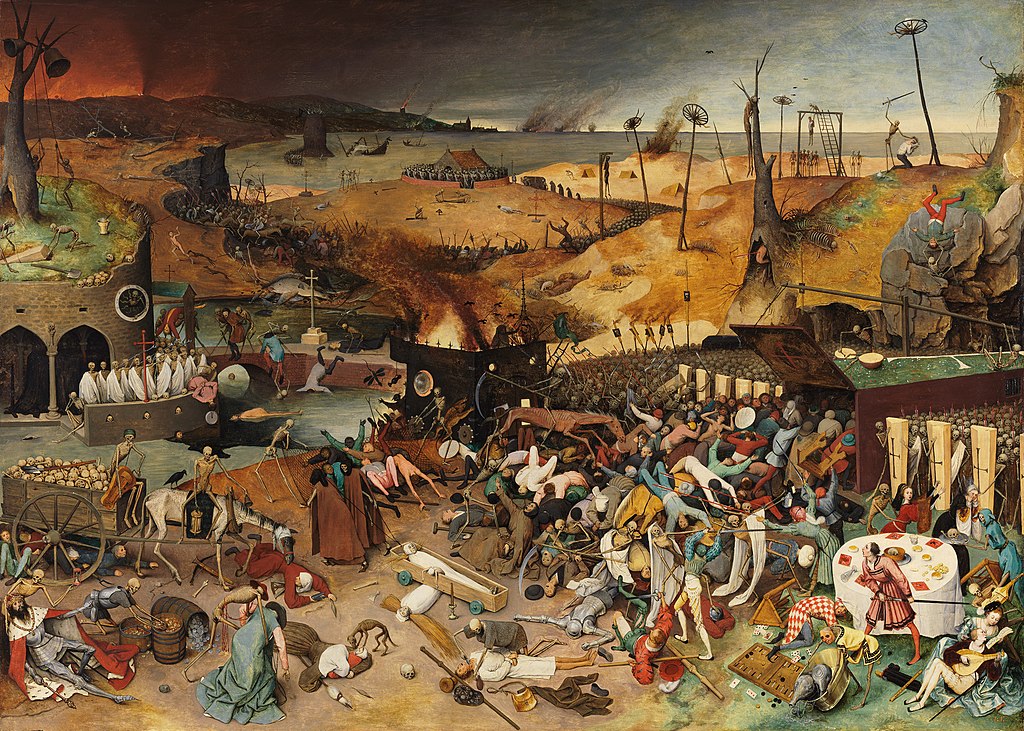
The Triumph of Death
Pieter Bruegel


What can you preach about?

In 1351, in a sermon no longer extant, but reported by the chronicler Jean de Venette, Pope Clement VI castigated the cardinals and other prelates and curial officials who had tried to get the Mendicant Orders condemned, or at least prevented from preaching.

“If the mendicants are silenced, what can you preach about? If on humility, you yourselves are the proudest, the most self-important and pompous in the whole world, if on poverty, you are the most covetous and greedy, if you preach about chastity–but on that we will say nothing–for God knows what each man does, and how many of you satisfy your lusts.”

Jean de Venette
Continuatio Chronici, pg 224

Seals and assurances

To put an exclamation point behind the promise that each individual is the object of God’s grace and that the benefit of Chris’s sacrifice is intended for each of us, God has given us the sacraments. They are seals and assurances meant for the individual, as distinguished from promises addressed to the whole world. In Baptism, God promises grace, pardon, and life eternal to one person at a time. Baptism unites the individual to Christ and all that he has done for our salvation. While the individual may decide to turn his back on the promise in Baptism, and reject its saving benefit, the promise stands. Should the fallen later hear the promise of the gospel and by its power return, the promise made by God in Baptism will remain firm and sure.

Just as firm and sure is the promise affixed to the Sacrament of the Altar. There we eat and drink the price of our salvation, Christ’s true body and true blood. There one repentant sinner after another, one at a time, comes to receive under the forms of bread and wine the Savior himself. In receiving the Savior, one at a time, each receives the promise Jesus made: “This is my body; this is my blood; it is given, it shed for you for the forgiveness of sins.”…What could be more certain or more sure than the grace and love of God for those Jesus has washed in Baptism and fed with himself at the altar?

Daniel M. Deutschlander
The Narrow Lutheran Middle (pg 19)

Am I a stone?

Am I a stone and not a sheep
That I can stand, O Christ, beneath Thy cross,
To number drop by drop Thy blood’s slow loss,
And yet not weep?

Not so those women loved
Who with exceeding grief lamented Thee;
Not so fallen Peter weeping bitterly;
Not so the thief was moved;

Not so the sun and moon
Which hid their faces in a starless sky,
A horror of great darkness at broad noon—
I, only I.

Yet give not o’er,
But seek Thy sheep, true Shepherd of the flock;
Greater than Moses, turn and look once more
And smite a rock.

Christina Rossetti

Suffering is not a problem

Suffering is not a problem, but an unfathomable, theoretically incomprehensible mystery. We should not try to explain suffering or construct theories about the reasons for suffering in the world and systematic explanations that seek to reconcile innocent suffering with belief in a good and all powerful God. The pervading presence of senseless suffering in the world falls outside the bounds of every rational system….When faced with the mystery of evil and suffering, the story of Jesus as the story of God is the only adequate response.

O Lord and Master of my life

O Lord and Master of my life, do not give me the spirit of sloth, despair, lust of power and idle talk, but grant rather the spirit of chastity, humility, patience and love to Your servant. Yea, O Lord and King, grant me to see my own transgressions and not to judge my brother, for blessed are You, unto ages of ages. Amen.

St. Ephraim of Syria
4th century